

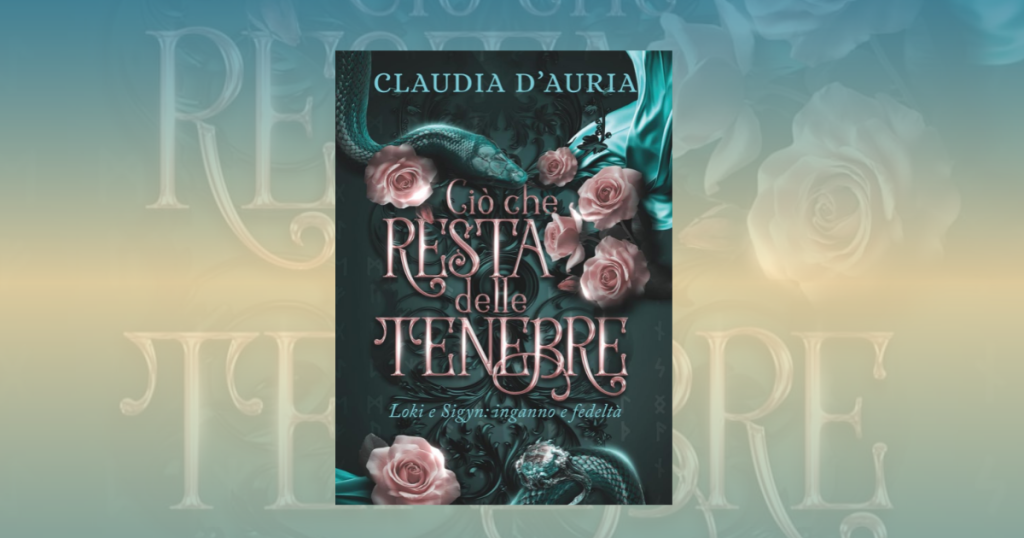
Norse mythology has captivated fantasy lovers ever since Tolkien drew upon it to create his world—and likely long before that. Thanks to the Marvel Universe, many of us have since come to know the charismatic and multifaceted characters of Thor and Loki, the warrior and the trickster. Today we present a literary debut that draws heavily from this tradition to tell a story of love and loyalty: “Ciò che resta delle tenebre” by Claudia D’Auria recounts the meeting between Loki and Sigyn, the woman who was given in marriage to a cursed god and who knew how to love him for what he was—or in spite of it.
C’era una volta la figlia di uno jarl.
Sigyn is a beautiful and curious young woman who has fallen in love with a skald passing through her father’s estate. But her father, the jarl, commits a terrible mistake by renouncing the ancient gods in favor of others, and so Odin punishes him by demanding that Sigyn be given in marriage to a vile troll. Loki, who, disguised as a skald, had noticed her charm, decides to defy Odin by taking the girl for himself: the only way to avoid Odin’s wrath and vengeance is to deceive his new bride, preventing her from recognizing him. And so, the two will get to know each other and fall in love in total darkness… until Sigyn will break their pact and Loki, the cursed, will lose his memory of their relationship.
Così, nello sguardo liquido e grigio di Sigyn, Loki lesse una determinazione che lo compiacque, perché era un guerriero e sapeva riconoscere il coraggio nei suoi avversari.
The love story depicted in this romantasy, based on the overused “forced marriage” trope, manages to avoid the red flags that have often been glorified in similar stories: the husband’s strength overpowering the wife’s sweet naivety, the blurred line between sharing and abuse, and violating consent. While the female protagonist is curious and her excitement for new discoveries could expose her to negative experiences; Loki proves to be an attentive and respectful lover, willing to give Sigyn all the time she needs to know him for his soul before giving her body to him, freely and eagerly. And when the veil of deception will fall and Odin will tear the lovers apart, erasing Loki’s memory of her, she will choose to go find him, despite all odds, to protect what they once shared and teach him how to love her again and again. Sigyn’s story is thus not one of submission, but of resilience and loyalty.
Perché non sopportiamo di morire da soli ed essere dimenticati è come morire.
Drawing inspiration from the storytelling style of ancient Norse skalds and sagas, the author’s writing does not follow the current trend of “show, don’t tell” or rely on a focused internal narrator, sacrificing some of its immediacy to establish an authoritative and atmospheric voice that guides the reader through the discovery of a complex story—as complex as the human experience itself. At times, the pace suffers as a result, causing key moments to lose their impact; nevertheless, with experience, the author may well be successful in her decision not to simplify the truth for the sake of the plot and thus cover decades of history with one, stand alone book. Surely, thorough research was conducted to recreate a setting coherent to the customs and traditions of the time.
In conclusion, “Ciò che resta delle tenebre” is a captivating retelling of Norse myths that blends an old-fashioned narrative voice with a modern sensibility, resulting in a heartfelt love story. The paperback book is meticulously crafted and refined in its presentation, one that deserves a spot on your bookshelf if you’re looking for a different experience in the landscape of Italian romance fantasy.

Title: Ciò che resta delle tenebre
Author: Claudia D’Auria
ISBN code: 9791281297654
Publisher: Spirito Libero Edizioni
What you will find in this book:
Forced marriage, but make it a green flag!
Norse mythology
Purple prose